


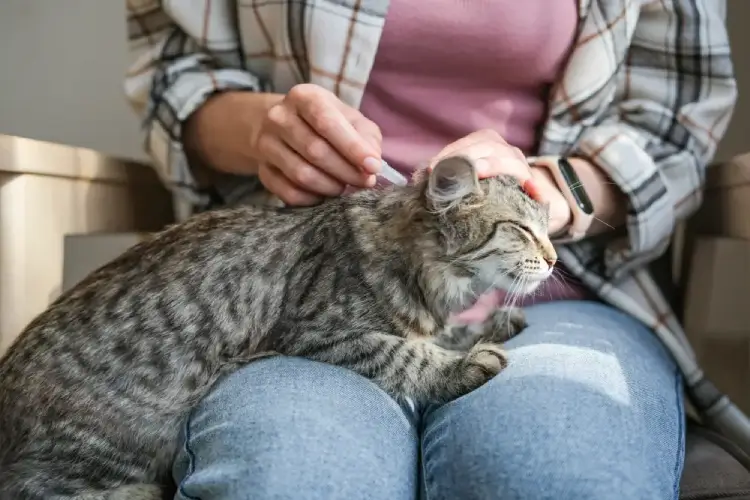
Your spot-on failed, but why? What most pet parents don’t realise is that to successfully eliminate flea infestations in the house, you’ve also got to treat your home environment – not just your pet.
While your spot-on medicine likely did the job and killed the adult fleas living on your pet, thousands of microscopic eggs are still hiding in your carpets, floorboards, and furniture, ready to hatch and kick off the cycle once again.
This article explains what to do if your flea spot-on “failed” and how you can eradicate these pests for good!
Does this returning flea infestation problem sound familiar?
“It couldn’t be, could it?” You tell yourself it’s just an itch, but on closer inspection of your fur baby, you spot them. Tiny, reddish black, and very much there. Ugh. Fleas – again. No wonder your dog’s been so restless recently! You fish out the spot-on treatment you’ve had in the cupboard, apply it and hope that’s the end of it all.
But a few weeks later, the nightmare is still going strong, and the itching hasn’t stopped. There are still fleas living on your poor pup and hopping around your home like they own the place. What gives? Is your flea treatment not working?
The thing is, your flea treatment is working. That’s not the issue. The issue is that after you’ve applied it, if you’ve not cleaned your furniture and your home properly, those pesky pets just hop back on your pet again.
Why your home is a breeding ground for fleas
Did you know that only 5% of fleas actually live on your pet? The other 95% have made themselves comfy in your home. In the carpets, hard floors, soft furnishings – all over! We know, it’s enough to make your skin crawl, but this is just the reality of how these tiny ectoparasites survive.
When you spot a flea on your dog, cat, or even one hopping around your home, you’re only seeing the adults. The rest of their crew are invisible to the naked eye, maturing in your carpet, skirting boards and burrowed under cushions – true incognito style.
If it feels like you’re fighting a losing battle, it’s because these tiny pests have a rigorous system in place. For every flea on your pet, there are dozens of others, all at various life stages. We’ll discuss the life cycle of fleas in the following section.
The Flea Life Cycle: Who is Hiding in Your Home?
Fleas might be tiny, but there are several stages to their lifecycle, which makes them difficult to get rid of. To get to the bottom of things, you need to understand why your home is loaded with these parasites, get to grips with their various life stages, and know how to take action and stop them in their tracks.
Those jumping adults you’re seeing are a big problem, but they’re really just the tip of the iceberg. The rest of the population is hidden in the depths of your home, developing and maturing into adults. This whole cycle can be completed in as little as two weeks, but experts like ESCCAP note that it can last up to 350 days in some cases. That’s why deep cleaning on a daily basis is a must and why you shouldn’t stop after a few days of inactivity, even if the adult fleas appear to have vanished.
We’ve put together the table below so you can understand more about each life stage and see how the population is divided:
| Life Stage | Description | Likely % in your home | Behaviour |
|---|---|---|---|
| Adults | These are the fully mature, biting, jumping pests you see on your pet. Once they find a host (your fur baby) they set up home, feed on your pet’s blood and start reproducing almost immediately. | 5% | $This is the only stage that lives on your pet. They can live for several months and will start mating after their first blood-meal. |
| Eggs | Flea eggs are pearly-white ovals that look like little grains of salt. Female adult fleas can lay up to 50 eggs per day, so eggs can be produced in massive numbers. | 50% | Unlike other parasite eggs, these ones aren’t sticky, so they can easily roll off your pet and seed themselves into your carpets and furniture. |
| Larvae | Once hatched, the next stage consists of small, translucent, legless worms. While they don’t bite just yet, they do feed on the flea dirt (digested blood) that falls off your pet. | 35% | Flea larvae are photophobic, which means they hate light. They will actively crawl away from open spaces and prefer burrowing deep into carpet fibres, floorboard cracks, and under skirting boards to prevent themselves from being seen. |
| Pupae | The larva protects itself by spinning a protective cocoon – this is called pupa. Inside the cocoon, they’ll transform into adults, however this stage can really vary in length; in warm, humid conditions, they can mature within 7-14 days. However, if the environment isn’t totally perfect, they can go into a quiescent state for 6-8 months. Once ready, the adult will break its way free from the cocoon, ready to latch onto a host. | 10% | This is the hardest stage to tackle as they’re pretty tough characters. They’re encased in a sticky, silk armour that is virtually resistant to chemicals. You must force them to hatch using heat and vibrations (like vacuuming) to trick them into thinking a host is nearby. |
Why your Spot-On didn’t “fail”
Many pet owners think that clearing up a flea infestation is a one-time job: apply the treatment, and that’s it. So, when they see fleas popping up again a couple of weeks later, they naturally assume the spot-on was ineffective.
However, it doesn’t work that way. Here is why the cycle keeps on going.
Invisible Eggs: Once a flea hops onto your pet, they’ll enjoy a blood meal and start reproducing straight away. A female adult flea can lay up to 50 eggs per day! These eggs aren’t sticky either; they roll off your dog or cat as they move. Every wag, tail flick, or shake invisibly scatters eggs throughout your home.
Untreated Home: If you aren’t treating your home alongside your pet, you’re not tackling the root of the flea infestation. Sure, you might kill the adult fleas on your pet, but your carpet will still be chock-a-block with eggs. To figure out how to get rid of all fleas, you have to look beyond your fur baby and start focusing on your home. Treat carpets, rugs, floorboards, soft furnishings, and even your car interiors.
The Cycle: Seeing a flea doesn’t mean the old ones didn’t die; it just means new ones have hatched in your home and hopped aboard your pet.
Human Error vs. Resistance: True resistance to flea medication is incredibly rare. We can say with confidence that the main reason fleas return is almost always down to environmental load or human error within the treatment routine.
How to get rid of all fleas (once and for all!)
Unfortunately, simply using a spot-on treatment on your pet isn’t enough to eliminate a whole flea infestation. The whole situation is a real strategic battle, so you must know when to strike tactically.
Use the following steps to defeat these pests and reclaim your home:
Step 1: Treat your pet
Adult fleas are the engine of the infestation; you must stop them from breeding immediately.
- Use trustworthy products: Use species-specific, weight-appropriate products from a reliable range like Bob Martin. These treatments are approved by vets and have had at least five years of rigorous testing to ensure they’re safe and effective.
- Be consistent: Flea control isn’t a one-off task. You must apply treatments regularly as directed to ensure there is never a ‘gap’ where opportunistic adults can start laying eggs again.
Treat every pet: Untreated animals keep infestations alive. Always treat every pet in the home, using the correct medicine for their species and weight. But do keep in mind that you’ll need to keep them separate after you have treated them. This is because if they groom each other, they could accidentally ingest the treatment, which could make them ill.
Step 2: Treat the Home
As you now know, 95% of the flea population lives in your home, so you must create a hostile environment.
- Use home furniture sprays: Choose Bob Martin Clear Home Spray Plus. It contains S-methoprene, an IGR (Insect Growth Regulator) that stops eggs and larvae from maturing for up to 12 months.
Safety: This product is for home furnishing use only; never apply to pets. The spray is suitable for use in households with cats and is intended for household use only. The spray contains Permethrin, which is toxic in high concentrations but safe to use in the low, controlled amounts found in Bob Martin products (such as sprays and collars) when instructions are carefully followed. This product must not be applied directly to cats nor are cats allowed to ingest the product. Please ensure that any cats in the home are excluded from rooms treated with the spray until it dries (4 hours would enable this). If you have fish tanks or other aquatic habitats, please ensure they are covered before use and remain covered until the treated area is completely dry.
Target hidden areas: Larvae are photophobic, so they can’t stand light. Focus your spray under sofas, behind skirting boards, and deep into floorboard cracks where they hide.
Step 3: Mechanical Removal
This physically removes the population and tricks the survivors out into the open.
- Wash at 60°C: Wash bedding and linens at 60°C+. This intense heat destroys the protective wax on eggs and kills pupae in their cocoons.
Good vibrations: Pupae are chemical-resistant, but you can trick them. Daily vacuuming creates vibrations that mimic a host, coaxing them to hatch and emerge into your treated carpets, where they can be eliminated.
How do I know when all fleas are gone?
The best way to tell that a flea infestation has totally cleared is if there’s zero sign of them after 21-days straight. In the right conditions, fleas can complete their cycle in 15 days, so adding an extra week or so provides enough overlap, but it all depends on the severity of the infestation – it could take months to completely eradicate them. That means you haven’t spotted any more of these pests, you’ve not been bitten and there’s no flea dirt (black specks) on your pets’ bedding. Bear in mind that pupae can lay dormant in your home for a while, so keep up with your treatment routine to ensure you defeat them all – even if it seems like things have cleared up after a few days.
Final Thoughts
Beating fleas can be a challenge, but with a strict cleaning routine and the right medication, you’ve got this! Stay consistent and you’ll soon have a happy, flea-free home.
Always follow the instructions on your chosen treatment to ensure it’s the correct match for your pet’s species, age, and weight. If you’re ever in doubt, your vet can help you tailor the perfect schedule for your pet’s specific needs.
FAQs
Why am I getting bitten by fleas if my pet is treated?
It’s really common for humans to get bitten, even after you’ve treated your dog or cat for fleas. Newly hatched fleas are opportunistic; they need to find a blood meal right away in order to survive. If your pet isn’t in the area once they hatch, they’ll latch onto the nearest warm-blooded host, often humans. Fleas can’t live or breed on humans, but they’ll still happily bite you if they’re searching for a meal.
How long does it realistically take to clear an infestation?
According to the CDC, moderate to severe flea infestations can take months to get fully under control. The life cycle of the flea is seriously complex, so it requires a multi-step approach to defeat them at every stage. To catch them during their chemical-resistant phases, you must provide follow-up treatments (as per guidelines), along with regular vacuuming to collect any eggs and create vibrations. The vibrations will help to coax the pupae into hatching. The process is definitely a marathon, but keep going and your hard work will pay off.
Do I need to give my indoor cat flea treatment?
Yes, it’s important to give your indoor cat regular flea treatment. They’re still susceptible to fleas, which can be brought into your home via eggs on clothing, shoes, from visitors, or could already be living in your carpet – especially if you’ve just moved home.
Can fleas give my pet worms?
Yes. Fleas can carry tapeworm larvae, and your dog or cat can become infected if they accidentally consume one. The tapeworm larvae then develop into adult worms in your pet’s gut. This is why it’s so important to regularly flea and worm your pet and give them the best protection possible.